

The Digital Trail: How Smartphones Are Changing Distracted Driving Cases
Request Free Consultation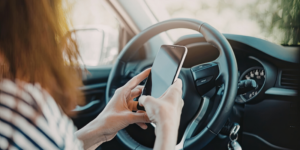
Every day, Missouri drivers share the road with someone whose eyes are on a screen instead of the road. Distracted driving has always been dangerous. But the smartphone era has redefined the risk in ways that go far beyond a quick glance at a text. And with new vehicle technology, evolving social media habits, and expanding legal discovery tools, accident victims and their attorneys have more evidence to work with than ever before.
For distracted driving victims, understanding the evidence landscape can be critical to a strong personal injury claim.
The Scope of the Problem
Distracted driving claimed thousands of lives in the U.S. last year, and Missouri consistently ranks among states with the highest fatality rates. The NHTSA (National Highway Traffic Safety Administration) estimates that at any given daylight moment, hundreds of thousands of drivers across the country are using a handheld device behind the wheel.
What makes smartphones uniquely dangerous is that they trigger all three types of distraction simultaneously: visual (eyes off the road), manual (hands off the wheel), and cognitive (mind off driving). No other single distraction hits all three at once quite like a phone.
Reading or sending a text takes an average of five seconds. At 55 mph, that’s the length of a football field — driven blind.
Emerging Dangers Beyond Texting
Awareness of texting and driving has grown, but smartphone habits have outpaced that awareness. Today’s distractions go well beyond a quick text.
Social Media and Short-Form Video
Scrolling TikTok or Instagram Reels while driving is increasingly common, especially among younger drivers. Unlike a text, video is designed to auto-play and hold attention. This creates extended periods of inattention rather than a brief glance.
Navigation and Vehicle Touchscreens
GPS apps require screen interaction even mid-trip, and modern touchscreen dashboards compound the problem. AAA research has found some car touchscreen systems demand more than 40 seconds of driver attention for basic tasks. Anything can happen for that long of a time.
Streaming Music and Podcasts
Manually switching playlists or browsing podcasts while driving carries the same visual and manual demands as texting, but rarely gets the same scrutiny.
New Sources of Evidence in Distracted Driving Cases
The smartphone age has created a detailed digital trail. Experienced personal injury attorneys know how to access it.
Cell Phone Records
Call logs, text timestamps, and data usage records can be subpoenaed in civil litigation. Active phone use at the time of a crash establishes a direct link between distraction and negligence.
App Activity and Screen Time Data
Smartphones log which apps were open and when. Not everybody realizes that. If a driver was on social media or watching video at the moment of impact, that data may be recoverable.
Event Data Recorders
Most modern vehicles have black boxes that capture speed, braking, and steering input in the seconds before a crash. Combined with phone records, EDR data can tell a complete story of what a driver was — and wasn’t — doing.
Dashcam and Surveillance Footage
Dashcams and traffic cameras increasingly capture distracted driving in real time. Video showing a driver looking down before a collision removes all ambiguity.
Missouri Law and Distracted Driving
Missouri’s distracted driving laws have changed significantly. The old law only banned texting while driving for drivers 21 and under — but the 2023 Siddens Bening Hands-Free Law extended that ban to all drivers, regardless of age. Penalties took effect January 1, 2025, starting at $150 for a first offense and escalating based on repeat violations or crash severity.
One caveat: it’s secondary enforcement, meaning officers can’t pull someone over for phone use alone. In civil litigation, though, that doesn’t protect a negligent driver. Digital evidence can establish liability with or without a citation at the scene.
What to Do After a Distracted Driving Crash
- Document everything: Photos, video, and detailed notes about driver behavior at the scene.
- Note what you observed: If you saw the other driver on their phone before the crash, record that observation as soon as possible because memory fades quickly.
- Move fast on evidence: Dashcam footage and surveillance video are often overwritten within 24 to 72 hours. Acting quickly can mean the difference between having key evidence and losing it.
- Contact an attorney promptly: Subpoenaing phone records and preserving vehicle event data is time-sensitive. Early legal intervention gives your case the best possible foundation.
The Floyd Law Firm: Fighting for Missouri Accident Victims
Distracted driving cases are more complex than ever — and so are the tools available to hold negligent drivers accountable. At The Floyd Law Firm, we know how to investigate these crashes, pursue digital evidence, and build the strongest possible case on your behalf. Our experienced personal injury team has helped Missouri accident victims navigate these cases and recover the compensation they deserve.
If you’ve been injured by a distracted driver in Missouri, don’t wait. Contact The Floyd Law Firm today for a free consultation. We’re here to fight for you.
Call The Floyd Law Firm at 314-863-4114.